Dating in a Culture of Hurry: Are We Truly Waiting on God?
I think as women today, we are often told to “put ourselves out there,” download the app, attend the speed-dating event, and meet as many potential partners as possible. The message is that love will not find us unless we actively market ourselves and create opportunities for romance.
But there is a difference between being open to the relationship God may bring and feeling responsible for making it happen ourselves.
Waiting on God is not passive. It is an active posture of prayer, preparation, trust, and obedience. It means believing that God is fully capable of directing our steps and arranging the right connections without our becoming anxious, striving, or presenting ourselves to a revolving door of strangers.
“Trust in the Lord with all your heart, and lean not on your own understanding; in all your ways acknowledge Him, and He shall direct your paths.”
Proverbs 3:5-6
Dating apps and speed dating can encourage us to evaluate and be evaluated within seconds. A person becomes a photograph, a brief description, a job title, or a carefully constructed profile. Instead of allowing character to be revealed gradually through community, accountability, consistency, and time, we may find ourselves making deeply personal decisions based on attraction, charm, and limited information.
For a woman seeking to be led by the Holy Spirit, this environment can become spiritually distracting. It can produce emotional attachment before trust has been earned, awaken desires before God has established the relationship, and consume time that could have been invested in our calling, healing, family, ministry, friendships, or growth in Christ.
Not every opportunity is a God-ordained opportunity. Not every person who expresses interest deserves access to our emotions, our bodies, our personal history, or our future.
Scripture tells us:
“Keep your heart with all diligence, for out of it spring the issues of life.”
Proverbs 4:23
Guarding our hearts does not mean living in fear or refusing to meet new people. It means recognizing that our hearts are valuable and should not be repeatedly handed to strangers for inspection, approval, rejection, or temporary entertainment.
Increasingly, women also face real safety concerns. Online profiles may be deceptive. Intentions can be hidden. People can misrepresent their relationship status, beliefs, character, identity, or motives. Private meetings with individuals who have not been observed within a trustworthy community can place women in unnecessarily vulnerable emotional, spiritual, and physical positions.
Biblical femininity is not about being helpless or silent. It is about carrying ourselves with wisdom, dignity, self-control, and discernment. A godly woman does not have to advertise herself, compete for attention, or make herself constantly accessible in order to be chosen. Her value is already established by God.
“Strength and honor are her clothing.”
Proverbs 31:25
There is something beautiful and dignified about allowing a man’s character and intentions to become visible through consistent action. A godly relationship should not require a woman to chase clarity, persuade someone to recognize her value, or remain available to multiple people while wondering which one may eventually choose her.
This does not mean that every Christian who uses a dating app is disobedient or that God cannot allow two people to meet through technology. Scripture does not specifically prohibit dating apps or organized dating events. The deeper question is whether we are moving from faith or from fear.
Are we acting because the Holy Spirit is leading us, or because we are afraid that God is taking too long?
Are we trusting God’s timing, or attempting to manage the outcome ourselves?
Are we seeking covenant, or craving attention, companionship, reassurance, or escape from loneliness?
What begins as “just seeing what is out there” can become months or years of conversations, disappointments, emotional entanglements, inappropriate messages, false hope, and wasted time. It can quietly train us to approach relationships through comparison, consumerism, and constant options rather than prayer, commitment, patience, and covenant.
A Spirit-led woman can be socially engaged, active in her church, involved in her community, and open to meeting people without placing herself in environments that disturb her peace or compromise her convictions. She can allow trustworthy people to make introductions. She can observe a man’s life within community. She can pray, listen, and allow God to reveal character over time.
Waiting does not mean that nothing is happening. God may be protecting us, preparing us, healing us, strengthening our discernment, or developing the person we will one day meet. The hidden season is not wasted simply because it has not yet produced a relationship.
A woman who waits on God is not falling behind. She is refusing to let loneliness rush her into a connection that discernment would have rejected.
She does not need to force an encounter, manufacture a relationship, or make herself vulnerable to every available possibility. She can live fully, serve faithfully, and remain peacefully open to whatever God chooses.
“He who finds a wife finds a good thing, and obtains favor from the Lord.”
Proverbs 18:22
There is a difference between hiding from love and refusing to chase it. There is also a difference between exercising reasonable initiative and striving to obtain something God has asked us to entrust to Him.
Ultimately, this is not about creating a legalistic rule for every Christian woman. It is about asking whether a particular method aligns with our convictions, protects our peace, honors our dignity, and reflects genuine dependence on God.
When the Holy Spirit is telling us to wait, continuing to search is not faith…it is resistance. No relationship gained through striving or disobedience will be worth the peace, protection, time, and spiritual clarity we surrendered to obtain it.
This brings us to an important distinction: the issue is not simply whether a woman is single, dating, or hoping to be married. The deeper issue is the posture from which she is seeking. Is she living from a place of purpose, wholeness, and trust in God; or searching from a place of restlessness, loneliness, insecurity, or fear that she may be overlooked?
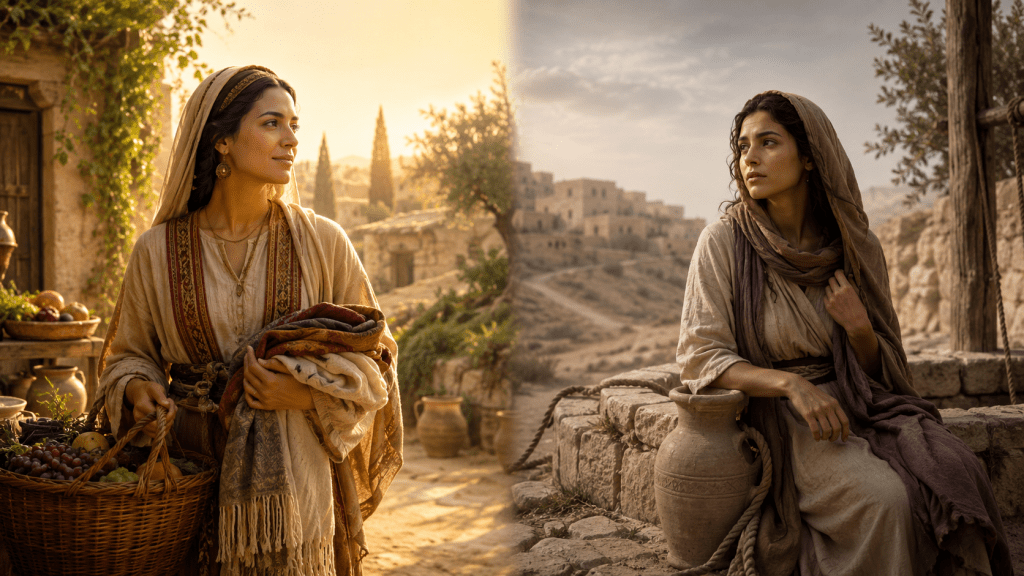
Scripture gives us two very different pictures of womanhood that invite honest reflection. One is a woman whose life is ordered by wisdom, diligence, dignity, purpose, and the fear of the Lord. The other is a woman who, before encountering Jesus, had repeatedly looked to relationships to satisfy a thirst that no human being could quench.
With that contrast in mind, here is something else to ponder:
Who do you believe would be more inclined to spend her time speed dating or endlessly scrolling through dating apps: the Proverbs 31 woman, whose life is marked by purpose, wisdom, dignity, diligence, and reverence for God…or the woman at the well, before her encounter with Jesus, who repeatedly sought in human relationships what only God could ultimately satisfy?
This question is not intended to shame the woman at the well. Her story is a testimony of grace, redemption, and transformation. Jesus did not condemn or discard her; He revealed Himself to her, restored her dignity, and redirected her thirst toward the living water only He could provide.
But her story should cause us to examine our own hearts. Are we seeking a godly husband from a place of peace and spiritual wholeness, or are we searching for a man to satisfy a loneliness, insecurity, longing, or emptiness that first needs to be surrendered to Christ?
The Proverbs 31 woman was not presented as searching anxiously for someone to choose her. She was occupied with the life, responsibilities, calling, and character God had entrusted to her. Her strength, wisdom, compassion, and fear of the Lord made her valuable long before a man acknowledged her value.
Perhaps the deeper question is not simply, “Where will I meet a husband?” but, “What kind of woman am I becoming while I wait?”
Am I becoming a woman whose heart is satisfied in Christ, whose life is filled with purpose, and whose steps are directed by the Holy Spirit? Or am I allowing loneliness and cultural pressure to send me searching through endless possibilities that may expose me to confusion, counterfeit connections, emotional distraction, and unnecessary vulnerability?
The woman at the well went searching for ordinary water and encountered Jesus. After meeting Him, she left her waterpot behind. What had brought her to the well no longer held the same importance because she had encountered the One her soul truly needed.
Before we go searching for someone to love us, perhaps we should ask whether we have become so satisfied in the love of Christ that we are willing to leave the waterpot of control behind and trust Him with who finds us, how we are found, and when that meeting takes place.